
FAQs
FAQs
Tea refers to both the plant and the drink.
The tea plant (Camellia sinensis, or Thea sinensis) was discovered in 2737 BC (according to Chinese mythology) by Shen Nong, the second of the three Chinese Emperors of the San Huang Period (3,000 - 2,700 B.C.). He was a scholar, the father of agriculture and the inventor of Chinese herbal medicine. His edicts required that all drinking water be boiled as a hygienic precaution. One summer day while visiting a distant region, he and the court stopped to rest, and his servants began to boil water for the court to drink. Dried leaves from the nearby bush fell into the boiling water, and a brown liquid was infused into the water. As a scientist, the emperor was interested in the new liquid, drank some, and found it very refreshing. The tree was a wild tea tree, and so, tea was created.
Tea the drink is made by infusing dry leaves of the tea plant in hot water. The name 'tea' is also the name of a mid-to-late-afternoon meal in United Kingdom and associated countries, at which tea (the drink) is served along with various foods.
Tea as a word has remained over the years as ‘cha’ in Chinese, Japanese and Portuguese, ‘te’ (pronounced approximately 'tay') in Fujian, ‘chai’ in Russian, ‘shai’ in Arab, South Asia and Turkey, and interestingly ‘Chai’ in Kiswahili. The English still call it tea while French call it ‘tee’.
There are different kinds of teas based on where it is grown (Kenyan teas, Indian teas, Ceylon teas, Darjeeling teas, Assam teas etc.); Method of growing (organic or conventional tea); Elevation of the growing area above sea level (high-grown, middle-grown and low-grown teas); Method of manufacture (CTC and orthodox teas, black, green, oolong, pure, instant, iced, white and silver tips teas); and Flavoring and scenting (Jasmine, Earl Grey, Lapsang Souchong, lemon, Tangawizi teas etc.)
Tea is grown in agro-ecological areas that meet certain set parameters. In Kenya these are set in the Agricultural Act, Cap. 318, Laws of Kenya; the Tea Research of Kenya (TRFK) Growers Handbook, EMCA No. 8 of 1999; the Forest Act, 2005; and the National Environment Management Authority (NEMA) environmental impact assessment license when establishing a new site to grow tea. The UN Food and Agriculture Organisation has its growing stipulations in the Good Agricultural Practices (FAO/GAP).
In Kenya, TRFK (now TRI) through scientific innovations has developed several clonal planting materials through vegetative propagation resulting in high yielding well adapted varieties. The selection of planting materials is enhanced by mapping the genetic and environmental conditions; where genotype – environment interaction trials are carried out as useful selection criteria for determining clonal genetic potential and adaptation so as to match the clones to specific areas where productivity can be maximized.
Tea is grown in areas endowed with ideal tropical, volcanic red soils and well distributed rainfall ranging between 1200mm to 1400mm per annum that alternates with long sunny days. Production goes on all year round in East Africa with two peak seasons of high crop between March and June and October and December which coincide with the rainy seasons. Kenya tea is grown free of agrochemicals because the ideal environment in which tea is grown acts as a natural deterrent to pests’ infestation and diseases attack.
In tea planting land is cleared of existing vegetation then prepared and levelled. Tea plants are typically started from cuttings (at times seedlings) and then planted in holes dug at the correct spacing to prevent overcrowding. The vegetatively propagated tea plants are planted in well-drained, fertile soil with adequate rainfall and sunlight. They are pruned into shrub-like forms and cultivated through practices like mulching, weed control, and regular fertilization. Tea is then harvested, picking the youngest leaves (flushes), which are then processed through steps like withering and oxidation to produce different types of tea.
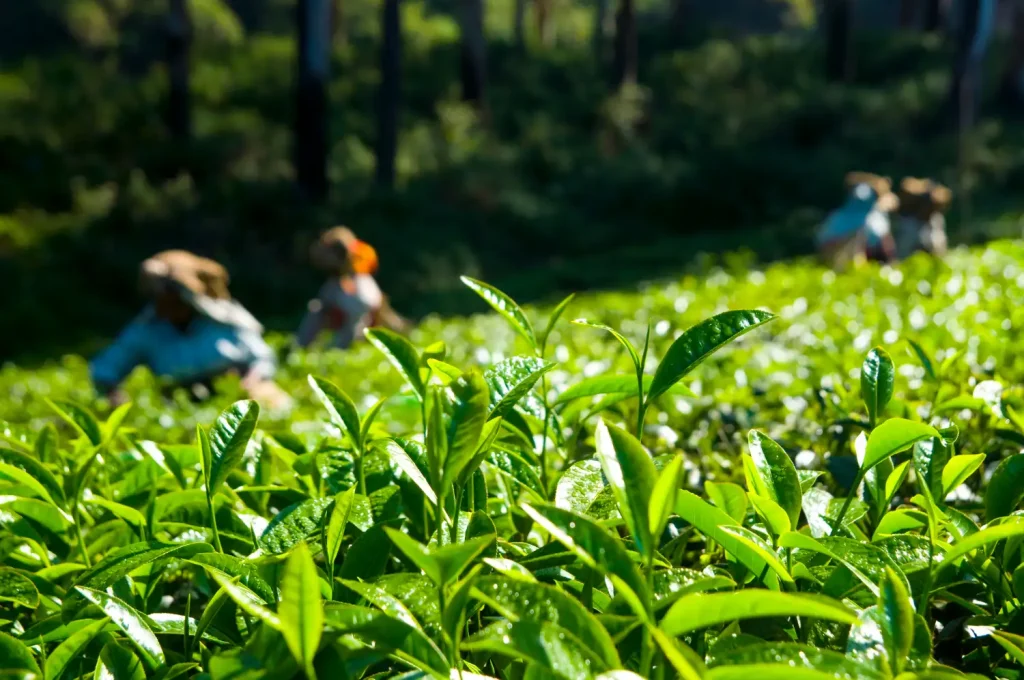
Regular pruning helps maintain a shrub-like form, which encourages the production of new shoots and makes harvesting easier. Regular application of fertilizers, particularly those rich in nitrogen, phosphorus, and potassium, is crucial for healthy growth. Farmers control weeds (and at times pests) to prevent poor growth. Harvesting (plucking) is mostly done by hand (with mechanical harvesting being adopted recently) in a delicate process of the new leaves (the "flush") and which stimulates the plant to produce more leaves, increasing yield.
Tea processing is the conversion of green tea leaves to dry leaves for brewing. The conversion processes are also called the methods of manufacture. The adoption of one method from another is driven by the intended final type of tea largely driven by the target market or at times the predominantly available method of manufacture.
The key distinguishing factors between the types of manufacture is the extent of oxidation the leaves undergo. The specific processing steps and their duration create a vast diversity of flavours, aromas, and colours.
The initial steps in processing of most teas include plucking (harvesting the best-quality tender leaves and the bud from the new growth) and withering (spread the leaves on trays or troughs to wilt and lose moisture to soften the leaves to promote initial flavor development and ready for further processing).
Black tea is fully oxidized; Oolong tea is semi-oxidized; Green tea is not oxidized; White tea is minimally processed Purple tea is a unique type of tea made from a special cultivar of the tea plant, typically grown in Kenya; Pu-erh Tea is created after fermentation where an additional aging and microbial fermentation process is added and compressed into bricks or cakes aged for long periods (at times years) to develop a smooth, rich flavor; and Yellow tea is processed like Green tea but slowly dried with an additional "sweltering" step where the damp leaves are lightly heated in a closed container causing the leaves to yellow and produces a mellow, distinct flavor. It all depends with the intended final product.
Whether Black, Oolong or Green tea, the principal method of manufacture is either CTC (Crush, Tear and Curl) or Orthodox.
The CTC method of manufacture is a mechanized process where after withering to reduce moisture, the leaves are fed into a CTC machine, which contains a series of cylindrical rollers with sharp, serrated teeth that Crush the leaves (rupturing their cell walls to release the enzymes and juices), then Tear them with serrated teeth into smaller, uniform pieces, and finally Curl the torn pieces into the distinctive small pellets or granules.
The Orthodox method of manufacture is also a mechanised process where after withering to reduce moisture, the leaves are fed into orthodox rollers for rolling and twisting (can also be done by hand) which ruptures cell walls and releases enzymes and cell fluids.
After the above CTC and Orthodox processes, the leaves are subjected to the oxidation processes depending on the intended type of final tea (Black or Oolong) or taken straight to drying for Green tea. Drying is the final stage of tea manufacture before sorting, grading and packaging. Drying stops the oxidation process, arrests fermentation, and reduces moisture content to a level that ensures preservation. The final product is then sorted and graded based on size and quality, resulting in different grades of manufacture for all teas ready for brewing and the market.
Bulk teas are packaged using multi-wall paper sacks lined with aluminium foil or polyethylene to protect the tea from moisture and odours. This preserves the freshness and protects the product during long-distance transit. Final shipments are palletised and loaded into containers for sea or air freight.
Packaging of teas into smaller, consumer-ready units (retail sale ready) at the source is also done for both exports and the local market. These are in various formats, including Tea bags (blended teas are put into tea bags, which can be single-cup, double-chamber, or pyramid sachets), Packets and pouches (Loose-leaf tea packed in smaller quantities), Airtight tins (especially for premium teas to maintain freshness), and Vacuum-sealed bags(for high-end teas to preserve quality). The retail-ready units are then put into larger cartons or corrugated boxes for protection during transport. Some cushioning materials like bubble wrap, foam inserts, or packing peanuts are used to fill voids and prevent shifting.
Many a times this question is at first answered with another question, whose quality? Real quality of tea with value attached to it is determined commercially at the market where prices are offered.
Along the tea value chain different players carry out their own quality analysis based on their interest. Producers have their strict quality control measure across the production processes to ensure the best possible quality product. Market players all the way to packers also carry out their own quality analysis to identify teas that match the profile of the teas they are looking for, either for further trading or to pack.
Generally, the parameters against which these quality analyses are carried out are largely agreed within the tea industry but without a common reference standard leaving everyone to carry their own, with the possibility of varied results by each individual. This somehow leaves tea quality analysis and determination a grey area and thence the earlier question, whose quality?
For example, Brokers offering teas at the auction on behalf of Producers carry out a quality analysis and determination exercise, which they use as the basis to place valuations on those teas ahead of preparing a selling catalogue and inviting Buyers to come and bid for the teas at the auction sale. These valuations are also influenced by the prevailing market conditions. Buyers at the auction carry out their own quality analysis ahead of bidding for the teas at the auction so as to pick the teas to bid for and the prices to offer. Packers also carry out a quality analysis to identify the teas that match their packing blends and brands.
Tea is prepared for consumption through a brewing process of steeping tea leaves in hot water to extract their flavor and aroma, then removing the leaves and serving the liquid. The steeping is done for a specific amount of time, often with the addition of hot water to the tea leaves in a pot or cup. After steeping, the tea can be customized with milk, sugar, honey, or lemon before being enjoyed.